 From the Bench
Between the Milk and the Mustard, a Peach CoQ10 Measured Out by the Teaspoon
MaryRuth's CoQ10 Liposomal is 75 milligrams per teaspoon, kept cold in the refrigerator door. I read its label on a park bench, set it beside what a day of food supplies, and checked what the studies in older men measured.

This is a paid advertisement. Sponsored by MRO MaryRuth, LLC.

One note before the bench: Frederick Hollis is a pen name, and the green bench in this story stands for many benches and many mornings.
Art, the man with the teaspoon, is a composite of several men we've talked with, not one real person, and nothing he does on this page is a result.
What this page says about the teaspoon comes from the seller's listing, its ingredient panel, its return terms and published studies.
All of it was read in September 2026.
There's a green bench by the pond in our park.
It has black iron arms, six wooden slats, and a fresh coat of paint every other spring.
On Tuesday and Thursday mornings, four or five of us end up on it after a lap around the water.
Nobody organized it. It just happened, the way these things do after sixty.
The loop is a little under a mile.
We walk it, we sit, and somebody opens a thermos.

You probably have a bench like this.
Maybe it's a porch, a diner counter, the back pew, or a phone call with your brother on Sunday nights.
And you probably know the small things that get talked about there.
Not the big news, just the ordinary stuff of being past sixty.
The rise on the far side of the pond feels a little longer than it did five years ago.
Getting up from the bench takes a hand on the iron arm now.
And by the second lap, if there is a second lap, the talking gets shorter.
Nobody complains about it, and nobody needs to.
None of that is alarming. It's just what the years feel like on a gravel path.
This spring, Art brought something new to the bench.
Not a grandchild, not a truck, not the ballgame: a teaspoon.
Every morning, he said, he takes a teaspoon of a peach-flavored liquid from a white bottle in his refrigerator door.
It stands between the milk and the mustard, and his daughter-in-law picked it out for him.
It's CoQ10, he told us, and he pronounced it like a license plate.
Then he asked the question that brought me here: "Is it worth twenty-eight dollars?"
Nobody on the bench knew.
One of the fellows thought it was a vitamin, another thought it was "the heart stuff," and I didn't know enough to say either way.
So I asked Art for a picture of the label.
I took it home, read everything the seller publishes, and then read the studies behind each line.
This page is that reading, laid out the way I'd explain it on the bench, with the numbers where you can check them.
It isn't a verdict, and it isn't medical advice.
It's a plain answer to five questions that came up that Tuesday.
- What is CoQ10, and where does it come from?
- How much do you already get from an ordinary plate of food?
- How much of what you swallow actually reaches your blood?
- What did the studies in men our age measure, and what didn't change?
- Is it worth twenty-eight dollars and a spot in the refrigerator door?
We'll take them in that order.
The bottle itself comes in about a third of the way down, once you know what to look for on it.
A Lap Around the Pond, at a Pace You Can Talk Through
Before the teaspoon, a word about the walk, because it's the reason we're on that bench at all.
It's also the one habit on this page with the longest paper trail behind it.

How fast should the lap be? Fast enough that you can talk but not sing.
That's the talk test, and the CDC counts walking at 2.5 miles an hour or faster as moderate effort. [1]
If you can only get out a few words before you need a breath, you've moved into vigorous territory.
Most mornings, our bench crowd stays comfortably in the talking range, and that's the whole idea.
Is there a number for the pace? There is, and it's a friendly one.
In a treadmill study of 98 healthy adults aged 61 to 85, about 100 steps a minute marked the start of moderate intensity. [2]
You can count that yourself on the flat stretch by the reeds.
Count your steps for fifteen seconds, and if you get to about twenty-five, you're there.

How much walking counts? The federal activity guidelines don't set a step number.
They say 10,000 steps a day is popular advice, not a guideline, and that bouts of any length count toward your week. [3]
For older adults, the same guidelines add balance work, and they ask you to set your effort by your own fitness, not someone else's. [4]
That last line is worth reading twice on a bench full of men comparing laps.
I bring all this up for a reason.
When Art talked about his teaspoon, he talked about it in the same breath as the walk.
He wasn't asking whether a teaspoon could replace the loop.
He was asking whether it belonged next to it, the way a thermos does.
That's a fair question, and it deserves a careful answer.
What Art Keeps in the Refrigerator Door
Art is a creature of habit, which is a compliment on our bench.
He's up at six, the coffee is on by five past, and the radio plays the farm report even though he hasn't farmed since 1990.
The teaspoon slipped into that routine without much fuss.
He opens the refrigerator, takes the white bottle out of the door, shakes it a little, and measures out one teaspoon.

Some mornings he takes it straight off the spoon.
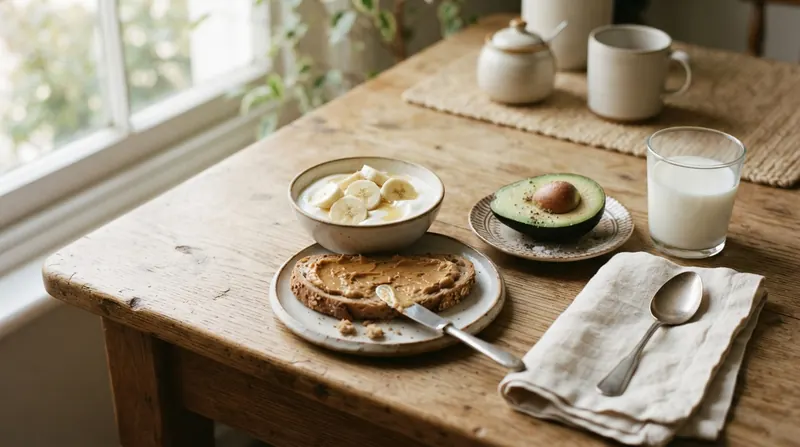
Most mornings it goes into the breakfast smoothie his wife makes, with a banana, a spoonful of peanut butter and plain yogurt.
Why the refrigerator? Because the seller says so.
The listing asks you to keep the bottle refrigerated, sealed or opened, and gives it six months once it's open.
That's why it lives in the door.
It's also why Art's daughter-in-law told him to put it where he'd see it every morning, next to the milk.
Art didn't choose it for any particular reason.
He liked the peach, he liked that it wasn't one more thing to swallow whole, and he liked that his daughter-in-law had thought of him.
None of that is a bad reason to keep a habit.
But it isn't an answer to his question, either.
So what was his question, exactly? Art had heard that CoQ10 has something to do with energy and with the heart.
He wanted to know whether that was true, and whether a teaspoon of it was worth what his daughter-in-law paid.
Those are two different questions, and the first one turned out to have a surprisingly clear answer.
The second one took more reading.
Something Your Body Already Makes
Here's the first surprise: CoQ10 isn't a vitamin.
Your body makes its own, in almost every cell, and you also take some in from food. [5]
That's the whole reason it isn't called a vitamin.
A vitamin is something you have to eat because you can't make it, and CoQ10 doesn't fit that description.
What does it do? It works inside the mitochondria, the small power plants in each cell.
There it helps turn the energy in the carbohydrates and fats you eat into ATP, the fuel the cell's machinery runs on. [6]

Think of a wood stove.
The logs are the food you eat, and the heat is the energy your cells can use.
CoQ10 is one of the parts inside the stove that make that happen.
It isn't fuel, and it isn't heat. It's part of the machinery in between.
It also has a second job.
In its reduced form, called ubiquinol, it sits in cell membranes and acts as an antioxidant, and it helps recycle vitamins E and C. [6]
Where is most of it? The heart is among the tissues with the most CoQ10 in the body.
In human tissue samples, the heart was one of the three tissues with the highest concentrations. [7]
A federal summary from the National Center for Complementary and Integrative Health says the same thing in plain words.
It describes CoQ10 as naturally present in the body, with the highest levels in the heart and a few other organs. [8]
That's where the "heart stuff" idea on our bench came from.
And it's true, as far as it goes: the heart is one of the places in the body that holds the most CoQ10.
But notice what that sentence says and what it doesn't.
It says where CoQ10 is found in the body, not what a teaspoon of it does once you swallow it.
Where something is found and what a spoonful of it does are two different questions.
Does the body make less of it with age? This is the part the advertisements like.
Tissue levels of CoQ10 fall gradually with age, in a number of tissues. [5]
But the same source adds two sentences that rarely make it into an advertisement.
It's unclear whether that gradual fall amounts to a shortage, and a shortage hasn't been described in the general population. [5]
In other words, you make less than you did at thirty, and nobody has shown that "less" means "not enough."
That's an honest place to start, and it's where I told Art the reading began.
Energy in the Cell, and Energy on the Path
Art's first question had the word "energy" in it, and so does the seller's page.
It lists "Energy Metabolism" and "Cellular Health" among the themes of this bottle.*
Those words are accurate, in the narrow way labels are allowed to be accurate.
CoQ10 does take part in how cells turn food into usable energy, and that's textbook biochemistry. [6]
But is that the same energy you feel on the second lap? Not necessarily, and this is the most useful distinction on the whole page.
The energy in a cell is a chemical reaction, while the energy you feel on a gravel path is a lot of things at once.
How you slept, what you ate, the weather, your knees, the company on the bench.
All of that shows up in how the second lap feels, and none of it is measured in milligrams.
A part of the stove is not the same thing as a warm kitchen.
So when a label says "energy," I read it as "this molecule is part of how cells make energy."
I don't read it as "you'll feel more energetic," because that's a different claim, and it needs a different kind of study.
Has anyone run that different kind of study? Yes, a handful of times, mostly in men and mostly on bicycles.
We'll get to them after the bottle, because they're the heart of Art's question and they deserve their own section.
For now, here's the short version of where we stand.
Your body makes CoQ10, the heart holds a lot of it, levels in tissue drift down with the years, and nobody has shown that the drift means you're running short. [5]
None of that is a reason to buy anything.
It's a reason to ask the next question, which is how much you already get from breakfast, lunch and supper.

Art laughed when I explained the stove on the bench that Thursday.
He said he'd been thinking of the teaspoon as gasoline, and I told him that was exactly the idea the label leaves you with.
It isn't gasoline.
At most, it's a spare part for a stove that already makes most of its own.
Three to Six Milligrams on an Ordinary Plate
The next thing I wanted to know was how much CoQ10 a normal day of food gives you.
The answer is a small number, and it's been measured more than once.
How much does a typical diet supply? About 3 to 6 milligrams a day. [9]
A review from Slovenia landed on the same range, and noted that about half of what we eat is already in the reduced form. [10]
A Danish survey came in at 3 to 5 milligrams a day, and found that about two thirds of it came from meat and poultry. [11]
So it isn't a vegetable story. It's mostly a meat, fish and cooking-oil story.
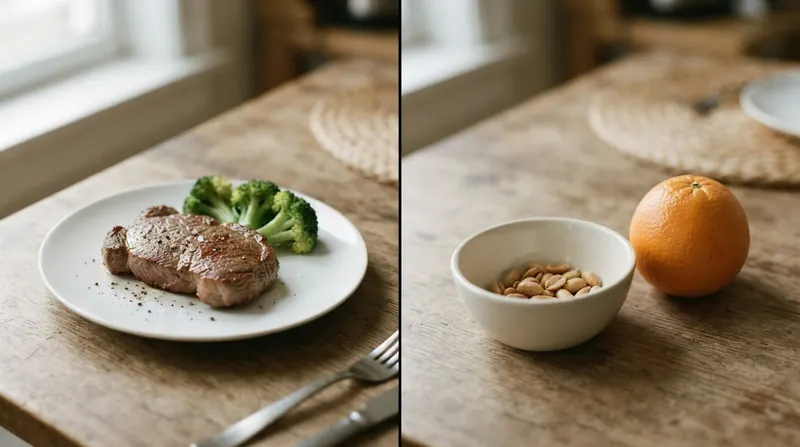
Here's what the Linus Pauling Institute at Oregon State University lists for a single serving of some everyday foods. [9]
- Fried beef, 3 ounces: about 2.6 mg
- Marinated herring, 3 ounces: about 2.3 mg
- Fried chicken, 3 ounces: about 1.4 mg
- Soybean oil, 1 tablespoon: about 1.3 mg
- Canola oil, 1 tablespoon: about 1.0 mg
- Steamed rainbow trout, 3 ounces: about 0.9 mg
- Roasted peanuts, 1 ounce: about 0.8 mg
- Boiled broccoli, half a cup: about 0.5 mg
- A medium orange: about 0.3 mg
- A boiled egg: about 0.1 mg
Now do the arithmetic Art and I did on the back of a receipt.
The teaspoon in his refrigerator door holds 75 milligrams.
How much beef is that? At about 2.6 milligrams per three ounces, you'd need about 29 servings of fried beef to match one teaspoon.
That's more than five pounds of steak, which even our bench wouldn't try.
Peanuts are worse.
At 0.8 milligrams an ounce, one teaspoon's worth would take about 94 ounces, nearly six pounds of peanuts.
One teaspoon holds what twelve to twenty-five days of ordinary meals hold.
There's one more kitchen detail in the Danish study that I liked.
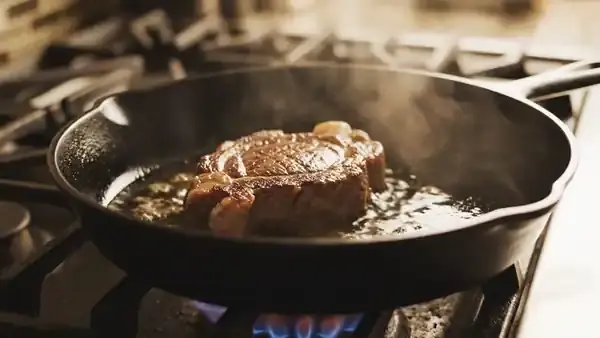
Frying destroyed 14 to 32 percent of the CoQ10 in the food, while boiling caused no loss they could detect. [11]
So is food "not enough"? Here's where I have to be careful, because this is where most pages cut a corner.
Nobody has shown that 3 to 6 milligrams a day is too little for a healthy person.
The source I trust most on this says plainly that a shortage hasn't been described in the general population. [5]
Food isn't failing you. It's just a much smaller amount than a teaspoon.
Supplements for adults usually provide 30 to 100 milligrams a day. [9]
The teaspoon, at 75, sits in the upper half of that range.
So the real question isn't whether you're running short.
It's whether taking in ten or twenty times what your plate gives you changes anything you'd notice.
To answer that, you first have to know how much of a swallowed dose actually gets into you.
The Trouble With a Fat-Soluble Molecule
CoQ10 has a stubborn habit: it dissolves in fat, not in water.
That one fact explains nearly everything about how it's sold.
How much of a dose gets into your blood? Less than you'd think.
Less than 5 percent of a dose taken by mouth is thought to reach the circulation. [12]
That's why the same source says it's best taken with a meal that contains fat. [12]
The fat in the meal gives it something to travel with.
What happens after you swallow it? It takes the slow road.
From the small intestine, bile helps package it with other fat-soluble nutrients, and it travels through the lymph to the blood, which typically takes 5 to 8 hours. [13]
Blood levels usually peak about six hours after a dose, and it takes about 33 hours for them to fall by half. [13]
So a steady level takes one to two weeks of daily use to build. [13]
That review was written by two people who work for a company that makes CoQ10, and they say so.
Their timeline is ordinary biology, and it matches what the university summary describes.
Does taking more mean absorbing more? Only up to a point.
Blood CoQ10 rises gradually with larger doses, but the share you absorb falls as the dose grows. [14]
Which is why the Oregon State summary notes that doses above 100 milligrams a day are usually split into two or three. [12]
A single teaspoon of 75 milligrams sits just under that line.
There's one more number worth knowing.
Food is estimated to provide about a quarter of the CoQ10 in your blood, and your own body makes most of the rest. [12]
That's a comforting thought on a bench.
You aren't an empty tank waiting to be filled; you're a working stove that makes most of its own parts.
Why Makers Wrap It in Tiny Bubbles
Because CoQ10 is so fussy about water, supplement makers have spent decades trying to make it mix.
Some dissolve it in oil, some make it water-dispersible, and some wrap it in tiny fat bubbles called liposomes.
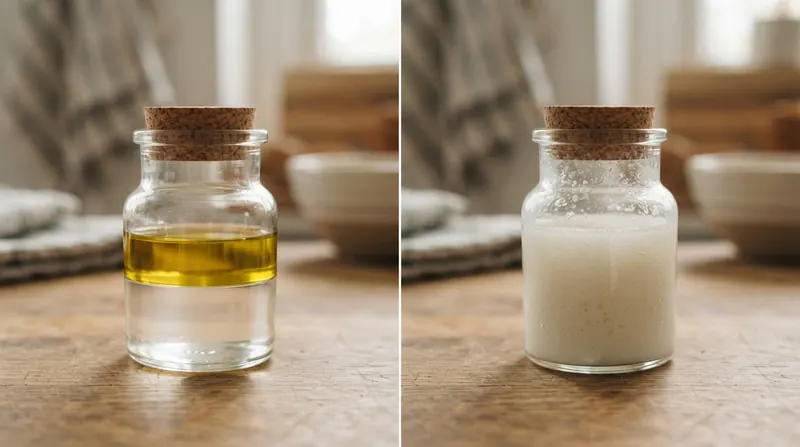
Do those forms make a difference in the blood? In several studies, yes, they raised blood levels more than plain CoQ10.
A review from Slovenia notes that forms with better water-solubility or dispersibility show improved bioavailability. [10]
In 21 healthy adults aged 65 to 74, a single 100-milligram dose of a water-soluble syrup delivered 2.4 times as much CoQ10 to the blood over 48 hours as standard capsules. [15]
That study was partly funded by the company that makes the syrup, and the syrup isn't the bottle in Art's refrigerator.
And in 18 healthy adults with an average age of 33, a single 100-milligram dose of a liposomal CoQ10 taken without food gave a 31 percent higher peak than the same dose of standard CoQ10. [16]
That one was a capsule of liposomal powder, not a liquid, and the company that makes it helped design and write the study.
So here's the honest shape of it.
Wrapped or dispersed forms tend to raise blood levels more, in studies of other products, often paid for by the people who make them.
No study I could find has measured the teaspoon in Art's door.
The seller calls it "Ultra Absorption," with a small dagger symbol, and doesn't cite a study of this bottle.
Ubiquinone or ubiquinol? You'll see both words on shelves, and people argue about them on benches like ours.
About 95 percent of the CoQ10 circulating in your blood is ubiquinol anyway, and taking either form doesn't change that ratio. [14]
In the study of adults aged 65 to 74, whatever form people swallowed, it showed up in the blood mostly as ubiquinol. [15]
So the argument matters less than it sounds.
That's enough background.
It's time to open Art's refrigerator door and look at the bottle itself.
The White Bottle in the Door
There it is, between the milk and the mustard.
It's a white plastic bottle with a peach and a wedge of orange on the front, and it holds 7.6 fluid ounces.
Who makes it? The front says MaryRuth's.
The seller's legal name is MRO MaryRuth, LLC, of Los Angeles, and it publishes a phone number, an email address and a street address.
What does one serving hold? One teaspoon, or 5 milliliters, holds 75 milligrams of CoQ10 as ubiquinone.
The bottle holds about 45 teaspoons.
What carries the CoQ10? A "liposomal blend" of 1.5 grams, made of organic sunflower seed oil and phosphatidylcholine.
The label gives the weight of the whole blend, not of each part.
The seller explains it this way.
The CoQ10 is packed into nano-sized micelles, which are then wrapped in liposomes, for what it calls enhanced absorption.
What else is in the teaspoon? Vitamin E, 6.7 milligrams, which is 45 percent of the Daily Value.
Then organic vegetable glycerin, purified water, citric acid and a citrus peach flavor, with small amounts of potassium bicarbonate, oleic acid, phosphoric acid and gum acacia.
The panel also lists 30 calories, 18 of them from fat, and 2 grams of fat per teaspoon.
That fat is the point. It's the sunflower oil the CoQ10 rides in.
There's also 4 grams of carbohydrate.
The front carries a no-sugar seal and the panel has no sugars line, but the glycerin base is sweet, and its carbohydrate counts.
A teaspoon of peach, 75 milligrams inside, and a little sweet fat to carry it.
How does the label say to take it? Adults 18 and over, one teaspoon a day, or as a healthcare professional recommends.
You can take it straight, add it to a blended drink, or pour it over food, and the label adds: "Do not exceed the recommended dose."
The listing asks you to shake it a little before using.
And it asks you to keep it cold: about 12 months sealed, and six months once opened and refrigerated.
Six weeks of teaspoons fits comfortably inside six months.
So the refrigerator rule isn't a problem, as long as the refrigerator is where you actually look each morning.
Is there anything on the label about age? Yes, and I was glad to see it.
The seller's page says anyone over 65, along with children under 12 and women who are pregnant or nursing, should check with a healthcare professional before using it.
That line applies to most of the men on our bench.
It isn't a scare, and I didn't read it as one; it's a sensible step, and it costs one conversation.
What does it cost? The seller listed it at $27.95 when I read the page, which works out to about 62 cents a teaspoon.
A subscription brings the bottle to $25.16, and shipping costs nothing on US orders of $49 or more.
What the Seller Says, and What I Left Out
Every label is a mix of plain facts and hopeful words.
My job on the bench is to sort them into two piles, and this bottle makes that fairly easy.
The plain facts: the amount of CoQ10, the form, the carrier, the vitamin E, the calories, the directions and the storage.
Those are printed, specific and checkable, and everything above comes from them.
The hopeful words: "Ultra Absorption," "Energy Metabolism" and "Cellular Health."
The first has no study of this bottle behind it, and the other two describe what CoQ10 does inside cells in general.*
The listing also makes a couple of broader claims that I've left out.
I couldn't find a study behind them for this teaspoon, and a page like this shouldn't repeat what it can't support.
Is there anything odd on the label? Two small things.
The front carries a no-sugar seal while the panel lists 4 grams of carbohydrate, which I've already mentioned.
And one buyer wrote in 2023 that the bottle she received had a different label design from the photo.
Labels get redesigned, so if yours doesn't match the picture exactly, that's probably why.
What about the price per milligram? At $27.95 for about 45 teaspoons, you're paying roughly 62 cents a day for 75 milligrams.
That's in line with what liquid CoQ10 tends to cost, and it's about what a cup of coffee at the diner costs on our side of town.
Plain facts on one side, hopeful words on the other. This bottle has more of the first than most.
The Other Lines on the Panel
The CoQ10 gets the big letters on the front, but there are other lines on the back.
Art asked about them, and they're worth a minute, because each one is there for a reason.
Vitamin E, 6.7 milligrams. That's 45 percent of the Daily Value in a teaspoon.
Vitamin E is a fat-soluble vitamin that works as an antioxidant in cell membranes, and in a liquid like this one it also helps keep the oils from spoiling.
There's a neat bit of chemistry between the two.
The reduced form of CoQ10 helps regenerate vitamin E in cell membranes, so the two tend to work side by side. [6]
I'm not going to claim the vitamin E does anything more for you at this amount.
The upper limit for adults is 1,000 milligrams a day, so 6.7 is a modest dose, closer to a handful of nuts than to a supplement bottle.
Sunflower seed oil. This is the fat that carries the CoQ10, the same oil you might cook with.
It's pure fat, rich in vitamin E, and here it makes up part of the 1.5-gram liposomal blend, less than you'd use to fry an egg.
Phosphatidylcholine. This is the main fat-and-choline molecule of cell membranes and of lecithin.
Lecithin is the emulsifier in egg yolk, soybeans and sunflower seeds, the ingredient that keeps oil and water mixed in things like mayonnaise.
Together, the oil and the phosphatidylcholine form the tiny bubbles, the liposomes, that the CoQ10 rides in.
The label gives you the weight of the two together, 1.5 grams, and not each one separately.
Vegetable glycerin and water. Glycerin is a clear, sweet, syrupy liquid obtained from plant oils, and it's the base of the liquid.
It's also where the sweetness comes from, and in large amounts it can loosen the stomach, which a teaspoon won't come close to.
Citric acid, peach flavor and the small stuff. Citric acid gives the tartness, the flavor gives the peach, and gum acacia helps hold the mix together.
Potassium bicarbonate, oleic acid and phosphoric acid each make up less than 1 percent.
Anything missing? The front seals say vegan, and the listing says it contains no dairy, soy or gluten.
If you're allergic to sunflower seeds, though, this isn't your bottle.
Seven lines on the back, and every one of them is doing a job you can name.
Two Trials in Men Who Could Sit on Our Bench
Now to the part Art really wanted.
Does taking CoQ10 every day change how a man in his sixties moves?
There are only a handful of trials that asked something close to that, and they're small and old.
But they're honest trials, with placebos, and two of them are worth telling in full.

The first trial: fifteen untrained men in their mid-forties took 150 milligrams of CoQ10 a day for two months, against a placebo. [17]
Their blood CoQ10 went up, and so did their own rating of their vigor on a simple scale.
But the things the researchers measured with machines didn't change.
Their maximal oxygen uptake, their lactate threshold on a stationary bike and the blood flow in their forearm all stayed where they were. [17]
Read that twice, because it's the whole story in one study.
More CoQ10 in the blood, a better self-rating, and no change on the instruments.
The second trial is the one that looks most like our bench.
It took trained men, 11 younger ones aged 22 to 38 and 8 older ones aged 60 to 74, and gave them 120 milligrams a day for six weeks, then a placebo, without them knowing which was which. [18]

In both age groups, blood CoQ10 went up.
But their maximal oxygen uptake didn't improve, and in a long cycling test, time to exhaustion was slightly longer after the placebo. [18]
That last detail is the kind that never makes it onto a label.
In this small trial, the men went a little further on the placebo than on the CoQ10.
Is that the whole picture? The Linus Pauling Institute looked across the athletic trials and reached the same place. [19]
Most trials of 100 to 150 milligrams a day, for three to eight weeks, found no difference in maximal oxygen use or time to exhaustion.
One found a 4 percent higher maximal workload on a bicycle, and two found greater improvement with the placebo. [19]
All of these trials were in men, most were small, and most were from the 1990s.
A higher number in the blood. Not a faster lap.
When I read this to Art on the bench, he was quiet for a moment.
Then he said it was about what he'd figured, and asked me what the self-rating of vigor meant.
What does a self-rating tell you? It tells you how people felt, in their own words, on a numbered scale.
It's real information, and it's also the kind of result a placebo can move, which is why the machines matter.
In the first trial, the men on CoQ10 rated their vigor higher, and the instruments didn't back it up. [17]
That doesn't mean they were wrong about how they felt; it means nobody can tell you that you'll feel the same.
The honest summary is small: a daily CoQ10 raises the amount in your blood, and in these trials that didn't turn into more stamina.
Is Seventy-Five Milligrams the Amount They Tested?
No, and it's worth being plain about that.
The trials used 120 and 150 milligrams a day, and the teaspoon holds 75. [17] [18]
So should you take two teaspoons? Not by this label.
The directions say one teaspoon a day, and they add, in so many words, "Do not exceed the recommended dose."
That's a sensible line, and I'd follow it.
If a bottle tells you one, it's one, whatever a trial used.
Does the liposome make up the difference? Maybe partly, and nobody can say by how much for this bottle.
In the one liposomal study I found, a different product raised the peak by about a third over plain CoQ10, in young adults, without food, after a single dose. [16]
That's a long way from "this teaspoon equals 150 milligrams."
It's also a long way from a trial that measured anything but a blood level.
Is a smaller dose absorbed better? In one sense, yes.
The share you absorb falls as the dose grows, so a modest dose isn't wasted the way a very large one partly is. [14]
And doses above 100 milligrams a day are usually split into two or three. [12]
At 75 milligrams, one teaspoon at breakfast is a single dose that doesn't need splitting.
What about stomach trouble? It's uncommon at this amount.
Stomach symptoms such as nausea, loose stools or heartburn have been reported mostly at 200 milligrams a day or more, and splitting the dose may ease them. [20]
And one reassurance I was glad to find: taking CoQ10 doesn't seem to switch off your own supply.
A review from a CoQ10 maker reports that supplements don't reduce the body's own production, and that CoQ10 doesn't build up in blood or tissue after you stop. [21]
So if you try a bottle and decide it isn't for you, you can simply stop.
Your own stove keeps making its own parts.
A Morning With the Teaspoon in It
Here's what a normal day looks like with the bottle in the door.
It's Art's routine, more or less, and it would fit most of the men I know.
Six o'clock. Coffee on, radio on, refrigerator door open.
Shake the bottle a little, as the label asks, and pour one level teaspoon.
Some mornings it goes straight from the spoon.
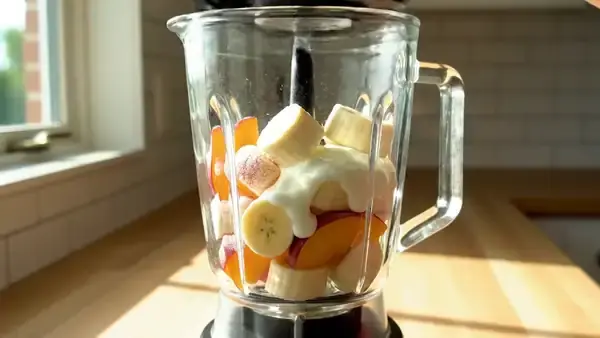
Most mornings it goes into the smoothie, with a banana, frozen peach slices, plain yogurt and a spoonful of peanut butter.
Why the smoothie? Partly taste, because several buyers find it very sweet on its own.
And partly the fat, because CoQ10 is best absorbed with a meal that contains some. [12]
Yogurt and peanut butter bring that fat along.
So does a slice of toast with butter, or an egg, if smoothies aren't your thing.
Six-fifteen. The bottle goes back in the door, between the milk and the mustard.
If it's a new bottle, write the date you opened it on the cap with a marker, because the seller gives it six months once it's open.

Eight o'clock. The walk.
One lap around the pond at a pace where you can talk but not sing, and a second lap if the knees agree. [1]
Eight-thirty. The bench.
The thermos comes out, somebody complains about the ballgame, and the teaspoon doesn't come up at all, which is how a habit should be.
Around lunchtime. Somewhere in here, the CoQ10 from breakfast reaches its peak in the blood, about six hours after the dose. [13]
You won't feel it happen, and nobody should tell you that you will.
Supper. Nothing to do with the bottle at all.
If it's a baked piece of fish, a pan of vegetables and a salad with olive oil, so much the better, and we'll come back to why near the end.
Nine at night. The refrigerator door opens again, for the milk.
The bottle is still there between the milk and the mustard, and that's the only reminder it needs.
The first two weeks. With daily use, blood levels build toward a steady level over one to two weeks. [13]
That's the whole timeline, and it's a quiet one.
Six weeks later. The bottle runs out, give or take a teaspoon.
That's a sensible point to ask yourself whether you liked the habit, and whether you want another bottle.
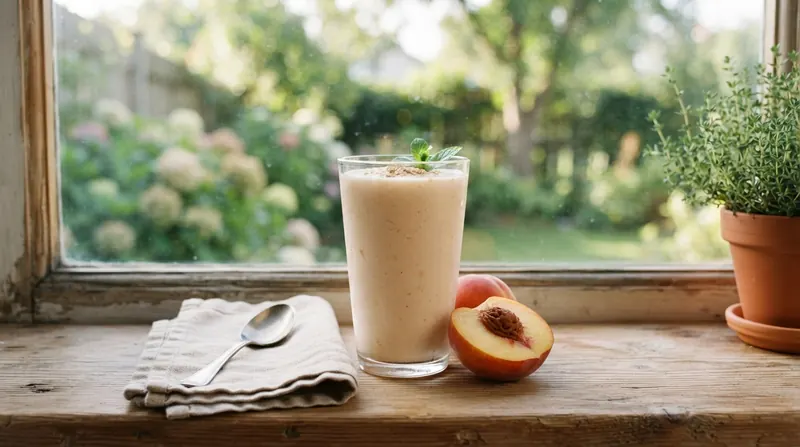
What will you notice? Honestly, the taste, first and most.
Buyers describe it as tart, peachy and sweet, and a few find it too sweet on its own.
What probably won't you notice? A faster lap.
The trials in older men didn't find one, at higher amounts than this teaspoon. [18]
Some people say they just feel better, and I'll show you one of those reviews below.
That's their experience, and it's worth hearing, but it isn't something I can promise you.
A teaspoon at six, a lap at eight, the bench at half past. The habit is the easy part.
Who It Suits, and Who Should Pass
Not every good product is for every man on the bench.
Here's how I'd sort it, based on the label, the seller's page and the studies.
It may suit you if:
- You'd rather take a teaspoon of liquid than one more thing to swallow whole.
- You like peach and don't mind a sweet, syrupy texture.
- You open the refrigerator every morning anyway, so the bottle won't be forgotten.
- You're curious about CoQ10 and comfortable with the idea that you may not feel anything.
- You'd rather try a six-week bottle than keep wondering.
It's probably not for you if:
- You're under 18; the label is for adults.
- You're allergic to sunflower seeds; the carrier is sunflower oil.
- You dislike very sweet flavors and don't want to hide it in food.
- You travel for weeks at a time without a refrigerator.
- You're hoping for a change you can measure on the path; the trials didn't find one. [17] [18]
And some people should ask first.
That's where the second note on this page comes in.
None of that is meant to worry you.
It's the same short list you'd want for anything new in the refrigerator door.
And please don't stop or change anything a clinician gave you because of a teaspoon, this page, or anything else you read.
The pharmacist is the right person to ask, and the question takes about two minutes at the counter.
The Questions Art Asked Next
Once the trials were on the table, Art's questions got more practical.
They're the same ones I'd ask, so here they are, with the plainest answers I can give.
"Isn't twenty-eight dollars a lot for a spoonful?" It's about 62 cents a day, or about 56 with a subscription.
That's less than a diner coffee, and it's still real money for something whose effect you may not feel.
"What if I can't stand the taste?" Then put it in something.
The label lets you add it to a blended drink or pour it over food, and yogurt hides sweetness well.
"How long before I'd know?" Blood levels settle in over one to two weeks, and the trials ran six weeks and two months. [13] [18]
One bottle covers about six weeks, which is a fair trial of the habit, if not of any promise.
"Would the other kind, ubiquinol, be better?" Probably not in any way that matters here.
Most CoQ10 in your blood ends up as ubiquinol whichever form you swallow. [14] [15]
"Can I double it to match the trials?" No.
The label says one teaspoon a day and not more, and I'd stick with the label.
"Will it make my own body lazy?" Not according to the review I found.
Supplemental CoQ10 didn't reduce the body's own production, and it didn't build up after people stopped. [21]
"What if the bottle looks different from the picture?" Labels change.
One buyer mentioned a redesign, and the seller's page is the place to check the current version.
"Does the time of day matter?" Only in that it should come with a meal.
Breakfast works because that's when the refrigerator door is open anyway, and a meal with some fat helps. [12]
"Can I take it to the cabin?" For a weekend, a cooler will do.
For longer, remember that the seller wants it cold whether it's sealed or open, so plan for a refrigerator at the other end.
"Is it the same as eating more fish?" No, and it isn't meant to replace fish.
A serving of herring or trout brings a couple of milligrams of CoQ10 along with everything else fish brings, while the teaspoon brings 75 milligrams of CoQ10 and a little oil. [9]
"Can my wife and I share a bottle?" You can, but it won't last long.
Two teaspoons a day would empty the bottle in about three weeks, so it's worth doing the arithmetic before you order.

"And if I just don't like it?" Then you stop, and you've learned something for about twenty-eight dollars.
The seller also offers a thirty-day promise, which is the next section.
Small questions, small answers. That's usually a good sign about a product.
The Seller's Thirty-Day Promise
Beside the buy button, the seller shows a thirty-day promise with the word "Happiness" in its name.
I read that as the seller's way of saying you can come back to them within a month if the bottle isn't for you.
What exactly does it cover? Read the seller's return policy for the exact terms before you order.
Keep your order date somewhere you'll find it, because thirty days go by quickly.
Shipping costs nothing on US orders of $49 or more, so a single bottle at $27.95 will carry a shipping charge.
The seller is in Los Angeles, and it publishes a phone line that takes calls or texts, weekdays from 10 to 7 Eastern.
Who do you contact? MRO MaryRuth, LLC, 1171 S Robertson Blvd #148, Los Angeles, CA 90035, at 310-955-1353.
That's a real street address and a real number, which is more than a lot of bottles can say.
What the Buyers Wrote
I always read the reviews last, after the label and the studies.
Reviews are what other people wrote on their own benches.
How many are there? The seller's page showed 96 reviews, averaging 4.6 stars, when I read it.
Seventy-three were five stars, sixteen were four, three were three, four were two and none were one.
Were the reviewers confirmed buyers? Some were.
Of the 75 reviews I could read through the seller's review system, 15 carried its purchase mark, and several seemed to appear twice under slightly different names.
That doubling usually means reviews were imported from somewhere else, so I don't lean on the count.
I lean on what people actually wrote.
Here are six of them, word for word, including a three-star and a five-star that says it made no difference.
They're opinions, not evidence, and the small pictures beside them are illustrations, not the reviewers.

Began using to keep my heart healthy as I approach 60! As far as seeing an improvement or any results, I don't show any difference. Great taste though!

I haven't been taking it long enough to see results, but I can say it is very sweet! I assume that's by design, if the taste of the supplement is very strong, but it could be a deterrent to taking it if you dislike glycerin-sweet taste and texture

Ideally, the product is great and I do not have any complaints, with exception to, the taste. I gave this a three-star rating specifically because this product is way too sweet to take on its own.

It's hard to explain but I just feel better when I take it

I absolutely love the taste of this product. It says you can add it to a beverage but I don't mind just taking it as a teaspoon! Highly recommend.

This is the best tasting liquid supplement from MRO I've tried so far. It's tart and peachy, yet sweet at the same time. I bought it for my heart health, but continue to stick to this brand for the taste.
What do I take from them? Carolee's is the one I'd read out loud on the bench.
She gave it five stars and said plainly that she doesn't see any difference, which is the most honest sentence in the stack.
The rest are mostly about taste.
Jo and Barbie find it too sweet on its own, while Madison and Michelle love it, and that split is worth knowing before you order.
Emily says she just feels better, and that's her experience in her own words.
It's worth hearing, and it's also exactly the kind of feeling the trials couldn't confirm on their instruments. [17]
None of them can tell you what the teaspoon will do for you.
But they tell you what kind of people buy it, what they notice, and what they don't.
Things That Cost Nothing and Have Long Studies
Before I close, there's a page I always add at the end of a reading like this.
It's the list of things that belong next to any teaspoon and cost nothing at all.
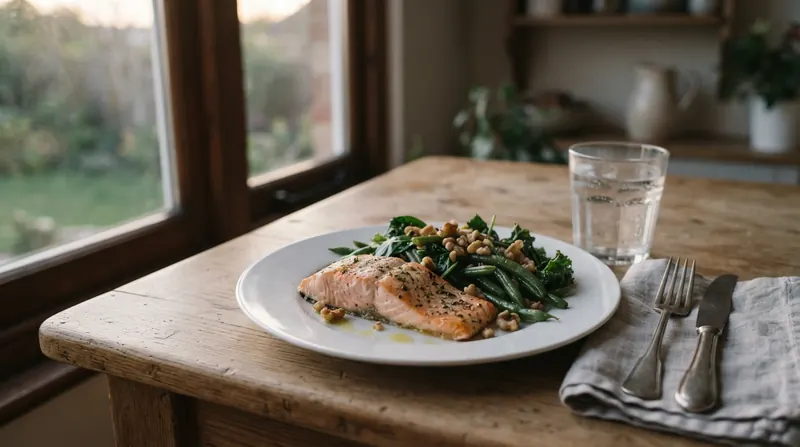
The walk, counted by the minute. The activity guidelines set a weekly range of 150 to 300 minutes of moderate activity, such as brisk walking, plus muscle-strengthening on two or more days. [22]
Bouts of any length count, even a few flights of stairs. [3]
A realistic start. The same guidelines suggest a time goal first, such as adding a 20-minute walk, about 2,000 steps, to an ordinary day of about 5,000. [3]
In healthy older adults, a daily half hour of moderate activity on top of ordinary movement works out to roughly 7,000 to 10,000 steps. [23]
Balance, too. For older adults, the guidelines add balance work alongside walking and strength, at an effort set by your own fitness. [4]
Standing on one foot while the coffee brews counts as a start.
The plate. The current dietary guidelines set goals of 3 servings of vegetables and 2 of fruit a day, and name olive oil, omega-3-rich seafood, nuts and seeds among sources of healthy fat. [24]
They also advise swapping deep-fried cooking for baked, broiled, roasted, stir-fried or grilled. [24]
That last one has a small bonus for this page.
Herring, trout and nuts are among the everyday sources of CoQ10, and frying cost the food up to a third of its CoQ10 in the Danish study. [9] [11]
The glass. Choose water and unsweetened drinks, avoid sugar-sweetened ones, and drink less alcohol. [25]
It's the cheapest line on this page, and one of the most useful.
The night. Adults are advised to sleep 7 or more hours a night on a regular basis. [26]
That's a habit to keep for its own sake, not something any teaspoon provides.
The cigarette. If you smoke, stopping helps at any age, no matter how long or how much you've smoked. [27]
Within a few days of quitting, the carbon monoxide in your blood drops to the level of someone who doesn't smoke. [27]
The yearly visit. Of the eight components in the American Heart Association's own scoring, four are daily habits and four are measurements best checked with a clinician. [28]
No teaspoon, bench or web page replaces that appointment.
The cheapest things on this list have the longest studies behind them.
None of these replaces the teaspoon, and the teaspoon doesn't replace any of them.
They're different lines on the same page, and a good morning has room for all of them.
The Whole Answer, on the Back of a Receipt
If I had to fit the whole reading on the back of the receipt Art handed me, here's what I'd write.
- What it is: a teaspoon of peach-flavored liquid with 75 mg of CoQ10 as ubiquinone, in sunflower-oil liposomes, about 45 teaspoons a bottle.
- Your plate: about 3 to 6 mg of CoQ10 a day, mostly from meat, fish and cooking oils. [9]
- Your body: makes most of its own, and tissue levels drift down with age without any shortage described. [5]
- Getting it in: with a meal that has some fat, peaking about six hours later, steady after one to two weeks. [12] [13]
- The trials in men: more CoQ10 in the blood, one better self-rating, no gain in aerobic capacity, at 120 to 150 mg. [17] [18]
- The cost: about 62 cents a day, kept in the refrigerator, six months once opened.
- First: a healthcare professional if you're over 65, and the pharmacist if you take anything daily. [20]
Forty-five teaspoons of peach for the refrigerator door
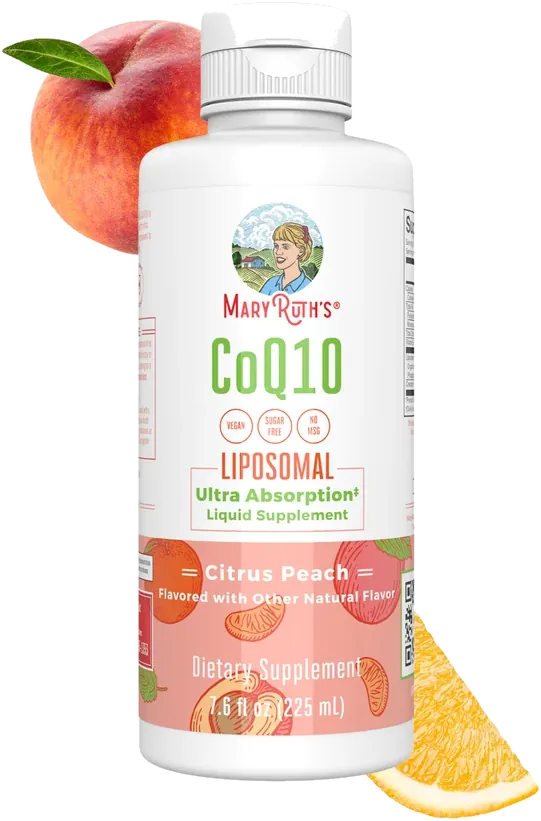
A teaspoon of tart citrus-peach liquid with 75 mg of CoQ10 carried in sunflower-oil liposomes, from a Los Angeles family company, kept in the fridge door.
CHECK AVAILABILITYSold by MRO MaryRuth, LLC, Los Angeles · 7.6 fl oz, about 45 one-teaspoon servings of 75 mg CoQ10 · keep refrigerated, six months once opened · shipping at no charge on US orders of $49 or more · a thirty-day promise from the seller
Questions from the bench
Is CoQ10 a vitamin?
No. Your body makes its own, and you also get a little from food. [5]
How much is in a teaspoon?
75 milligrams of CoQ10, as ubiquinone.
How much do I already get from food?
About 3 to 6 milligrams a day. [9]
Does it have to be refrigerated?
Yes. The seller says to keep it cold, sealed or opened, and to use it within six months of opening.
Should I take it with food?
A meal with some fat is the usual advice for CoQ10. [12]
How long does a bottle last?
About 45 teaspoons, a little over six weeks at one a day.
Is it sweet?
Yes. Most buyers describe it as tart, peachy and sweet.
Is it ubiquinol?
No, it's ubiquinone. Most CoQ10 in the blood ends up as ubiquinol either way. [14]
Will it make my walk easier?
The trials in men didn't find better aerobic capacity, at higher amounts than this teaspoon. [18]
I'm over 65. Is there anything to do first?
The seller asks anyone over 65 to check with a healthcare professional before using it.
Should anyone else ask first?
Yes. If you take anything daily, show the label to your pharmacist before the first teaspoon. [20]
Back on the Bench
I read all of this to Art on a Thursday at the end of September.
The ducks were loud, the thermos was half empty, and one of the fellows had fallen asleep with his cap over his eyes.

Here's where the reading landed.
The teaspoon is exactly what its label says, and the label is more specific than most.
It holds 75 milligrams of a molecule your body already makes, about what twelve to twenty-five days of ordinary meals provide.
It comes in a form built to mix with water, and it asks for a refrigerator and a little fat at breakfast.
Does it do what Art hoped? The chemistry behind "energy" is real, but it's cell chemistry.
The trials in men our age found more CoQ10 in the blood and no faster laps. [18]
So the honest answer to his question is a modest one.
It's about twenty-eight dollars for six weeks of a habit you may enjoy, with real chemistry behind it and no promise you'll feel it.
Art listened to the whole thing.
Then he said he'd finish the bottle because he likes the peach, and that he'd keep walking the loop either way.
I thought that was about right.
He didn't say he felt any different, and I didn't ask him to.
A teaspoon in the door, a lap around the pond, and a bench to sit on afterward. Only one of them costs money.
If you decide to try a bottle, you now know what's in it, how to take it, and what the studies did and didn't find.
If you decide not to, the walk, the plate and the bench are still there, and they cost nothing.
Either way, I hope your own bench is full this week.
And I hope the second lap feels like a good idea.

Sold and shipped by MRO MaryRuth, LLC, Los Angeles. The price and any promotion are set by the seller.
Every line of the panel, with its amount, what each ingredient is and what the research does and doesn't say about it, is written out in the ingredient and advertising guide linked at the foot of this page.
The guide also covers the carrier oil, the vitamin E and the sweet base, and the two questions worth asking your pharmacist.